Compute Chips

China’s TPU Breakthrough: How Zhonghao Xinying Filled the Pure TPU Architecture Gap
China’s AI chip industry is often discussed through GPUs and neural-processing units. Zhonghao Xinying offers another route: a processor designed around tensor computation, supported by its own instruction set and computing platform.

More Threads and Biren’s GPU Iteration Race: China’s General-Purpose AI Compute Path
China’s domestic AI hardware effort is not following one architectural route. Some companies emphasize specialized neural processors. Others are pursuing programmable GPUs that can support a broader mix of training, inference, and general computing workloads.

Nvidia’s $1 Trillion Revenue Target by 2027: Behind the AI Factory Transformation
Nvidia’s trillion-dollar ambition is not a forecast of $1 trillion in revenue during the single year 2027. It is a statement about the cumulative business opportunity associated with Blackwell and Vera Rubin through that period—and about the scale of infrastructure customers may need as AI moves into continuous operation.

Vera Rubin Platform Breakdown: 7 Chips, 5 Racks, and a 10x Inference Efficiency Leap
Nvidia’s Vera Rubin platform is easiest to understand as a coordinated AI infrastructure system, not simply a new GPU surrounded by accessories. Its components divide responsibility across computation, networking, storage, and orchestration so that fewer resources sit idle while another part of the system becomes a bottleneck.

Nvidia’s Groq 3 LPU: The Inference Coprocessor That Could Reshape AI Server Architecture
For years, the AI infrastructure conversation has revolved around a familiar question: how many GPUs can a data center deploy? Nvidia’s Groq 3 LPU suggests that the next question may be more interesting: which parts of an AI workload should actually run on those GPUs?

Liquid Cooling for 1000W+ AI Chips: The Infrastructure Bottleneck Nobody Priced In
The accelerator arrives. The server vendor has completed its work. The software team is ready to begin testing. Then the deployment stalls because the building cannot remove enough heat.

AI Chip Yield Challenges at 3nm: The Cost of Advanced Node Scaling
A smaller manufacturing node promises more computing capability within a constrained footprint. For AI chips, that can mean additional arithmetic units, improved energy efficiency, or room for functions that would be difficult to accommodate on an older process. The attraction is obvious. The economics are less automatic.

TPU 8t Commercial Launch: Can Google’s Custom Silicon Finally Challenge Nvidia’s Moat
Google’s TPU 8t can challenge Nvidia in selected large-scale AI workloads, but it does not need to replace GPUs everywhere to matter. Its strongest opportunity is to make Google’s infrastructure an attractive alternative for customers willing to optimize models and software around a different computing platform.
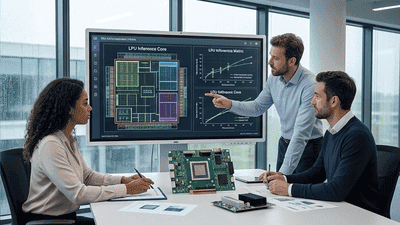
Custom Silicon for Inference: Why Hyperscalers Are Designing Their Own LPUs
The economics of AI change when a model moves from development into daily use. Training attracts attention because it requires spectacular computing resources. Inference creates the recurring bill: every search, generated answer, recommendation, and coding suggestion consumes computing capacity.

The Post-Moore Path for AI Chips: Advanced Packaging Succeeds Process Scaling
For decades, the semiconductor industry rode a remarkably simple storyline: shrink transistors, pack more of them onto a die, and enjoy automatic gains in performance and efficiency. That story—embodied in Moore’s Law—still matters, but for AI chips in the mid‑2020s it is no longer the sole, or even primary, driver of progress.